OEM/ODM Instrument Transformer Manufacturing: Engineering Technical Guide
An authoritative technical analysis on current transformers (CT), potential transformers (PT/VT), magnetic core material selections, dielectric insulation advances, and customized manufacturing for global EPC contractors.
1. OEM/ODM Manufacturing Ecosystem for Instrument Transformers
Custom Engineering, Core Topology, and Insulation PhysicsIn modern electrical power networks, Instrument Transformers (ITs)—comprising Current Transformers (CTs) and Potential/Voltage Transformers (PTs/VTs)—serve as the critical sensory organs for metering, control, and protective relaying. Unlike standard distribution or power transformers designed primarily for energy conversion, instrument transformers are engineered to step down extreme high voltages and currents to standardized, safe, and precise secondary values (typically 1A/5A for CTs and 100V/110V for PTs) while preserving exact phase relationships and waveform integrity.
As a premier OEM/ODM instrument transformer manufacturer operating since 1991, our manufacturing facilities integrate advanced metallurgy, high-vacuum epoxy encapsulation, automated toroidal coil winding, and full-spectrum dielectric withstand testing. Global procurement teams from public utilities, solar farm developers, and industrial switchgear original equipment manufacturers (OEMs) demand customized physical dimensions, custom transformation ratios, and ultra-low phase displacement error classes (0.1, 0.2S, 0.5) to withstand complex environmental stress and grid harmonics.
Information Gain Note for Procurement Directors
Standard off-the-shelf instrument transformers frequently fail in harsh environment deployments (such as offshore wind or electric arc furnace operations) due to uncalculated thermal stress and harmonic saturation. Custom OEM/ODM manufacturing allows tailored selection of magnetic core permeability, thermal insulation class (H-Class 180°C or C-Class 220°C), and partial discharge suppression below 5 picocoulombs (pC) at 1.2Un.
2. Core Metallurgy & Engineering Specifications Matrix
The accuracy class and dynamic performance of an instrument transformer rely heavily on the magnetic core topology and winding arrangement. Below is an engineering overview comparing raw core materials utilized in our custom OEM/ODM production processes:
| Core Material Type | Initial Permeability (μi) | Saturation Flux Density (Bs) | Typical Accuracy Class | Primary Application Target |
|---|---|---|---|---|
| Nanocrystalline Alloy | > 80,000 | 1.2 Tesla | Class 0.1, Class 0.2S | Ultra-Precision Revenue Metering CTs |
| Nickel-Iron (Mu-Metal) | 50,000 - 100,000 | 0.75 Tesla | Class 0.2S, 0.2 | High-Accuracy Laboratory Instrument PTs |
| Cold-Rolled Grain-Oriented (CRGO M3/M4) | 10,000 - 15,000 | 1.9 Tesla | Class 0.5, 5P20, 10P20 | Industrial Protection & Grid Substation CTs |
| Amorphous Metal Core | > 40,000 | 1.56 Tesla | Class 0.2 / 0.5S | Compact Smart-Grid & Renewable Sensors |
Our engineering team selects core geometry—ranging from gapless toroidal cores for zero flux leakage to cut-C cores for rapid assembly—based on the specific short-circuit withstand rating ($I_{th}$) and thermal current limits required by the project specifications.
Custom OEM/ODM Manufacturing Capabilities
Vacuum Pressure Impregnation (VPI)
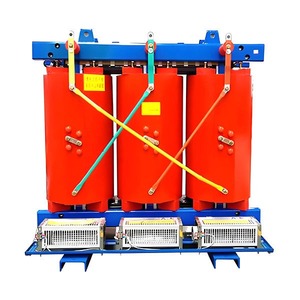
Utilizing high-solids solventless epoxy resins, our VPI dry-type instrument transformers eliminate internal air voids, achieving zero partial discharge (<5pC) and superior thermal dissipation for indoor high-rise and metro substations.
High Short-Circuit Dynamic Withstand
Engineered to endure extreme electrodynamic forces during power grid faults. Primary windings feature high-grade electrolytic copper with reinforced mechanical clamping to achieve up to 2.5 times rated short-time thermal current ($I_{dyn}$).
Third-Party ERDA & CPRI Type Certified
Every OEM design undergoes rigorous type-testing in accredited laboratories (CPRI & ERDA) for Basic Impulse Level (BIL) lightning surges up to 250kV, temperature rise testing, and acoustic noise verification.
3. Future Procurement & Global Industry Development Trends
Market Outlook 2025–2035: Digitalization, Eco-Fluids, and Smart Grid AlignmentA. Transition to Digital Substation Architectures (IEC 61850-9-2)
The global electrical transmission and distribution landscape is undergoing a massive shift from conventional analog signal transmission to digital process buses. Conventional instrument transformers output high-power analog signals (5A, 100V) requiring thick copper cables. Next-generation procurement strategies emphasize Low-Power Stand Alone Sensors (LPITs) and optical current transformers (OCTs) integrated with Merging Units (MUs) complying with IEC 61850-9-2 LE protocol.
Our OEM manufacturing lines are evolving to support hybrid configurations where low-power secondary outputs (such as 225mV or Rogowski coil integration) are built directly into cast-resin medium-voltage transformers, dramatically reducing switchgear footprint and copper consumption.
B. Eco-Friendly & Biodegradable Dielectric Insulants
With strict environmental regulations such as EU REACH and global decarbonization mandates, electrical utilities are actively phasing out mineral oils and $SF_6$ gas. Modern instrument transformer procurement is shifting toward Synthetic & Natural Ester Dielectric Fluids (K-class fluids with fire points > 300°C) and advanced Cast Resin / VPI dry-type designs. Ester-filled voltage transformers offer self-extinguishing properties, biodegradability within 28 days, and extended operational lifespan under elevated ambient temperatures.
C. Solar & Offshore Wind Grid Integration Stress
Renewable energy expansion introduces high-frequency switching harmonics, DC offset currents from solar inverters, and rapid temperature fluctuations. Modern ODM specifications require instrument transformers equipped with electrostatic shielding between primary and secondary windings to bypass common-mode noise, alongside anti-ferroresonance damping circuits in potential transformers to prevent catastrophic core saturation during switching transients.
4. Enterprise OEM/ODM Manufacturing Competencies
Founded in 1991 in Mumbai, India, Urja Techniques (India) Pvt. Ltd. has established itself as an engineering benchmark for specialized transformers. Our state-of-the-art production complex provides end-to-end OEM/ODM custom contract manufacturing tailored to international buyers.
- ✓ ISO 9001:2015, ISO 14001:2015 & OHSAS Certified: Strict quality management systems integrated across raw material inspection, winding, vacuum impregnation, and routine testing.
- ✓ In-House Temperature Rise Testing Bay: Equipped with automated temperature loggers and multi-channel load banks to verify thermal dissipation under full rated burden.
- ✓ Registered State & Global Utility Supplier: Pre-qualified by major state electricity boards, turnkey EPC firms, and industrial conglomerates across 40+ countries.
- ✓ 100% High-Purity Electrolytic Copper Winding: We utilize high-grade enamelled and paper-covered copper conductors ensuring low $I^2R$ losses and superior mechanical strength.
- ✓ Custom Mechanical Dimensions: Flexible enclosure designs (IP20 to IP66, NEMA 4X) and customized bushing positions to match retrofitting needs in legacy substations.
- ✓ 40% Revenue Export Driven: Robust international logistics network experienced in sea-worthy crating, tropicalized insulation protection, and global customs documentation.